
Nonnav · Updated August 22, 2026 · Estimated read time: 9 minutes
Key Takeaways
- A full excavator GPS guidance retrofit runs $12,000 to $20,000 for a dual-antenna GNSS + IMU system, $8,000 to $15,000 for total station, and $2,000 to $5,000 for laser guidance.
- The price is only half the story. Setup time, RTK subscription, calibration, and operator training add $1,500 to $3,000 to the first-year cost of a GNSS system.
- A mid-size contractor typically recovers the investment in 2 to 4 months on precision-heavy work. The payback formula in this guide lets you calculate your own number before you buy.
$14-25k
±3cm First-Year Total
$7-12k
±10cm First-Year Total
2-4 mo
Typical Payback
60%
Usage Threshold for Payback
What Drives the Price of an Excavator GPS Guidance System
Excavator GPS guidance is not one product with one price. It is a stack of hardware and services, and each layer has its own cost. Before comparing quotes, it helps to know what you are actually paying for.
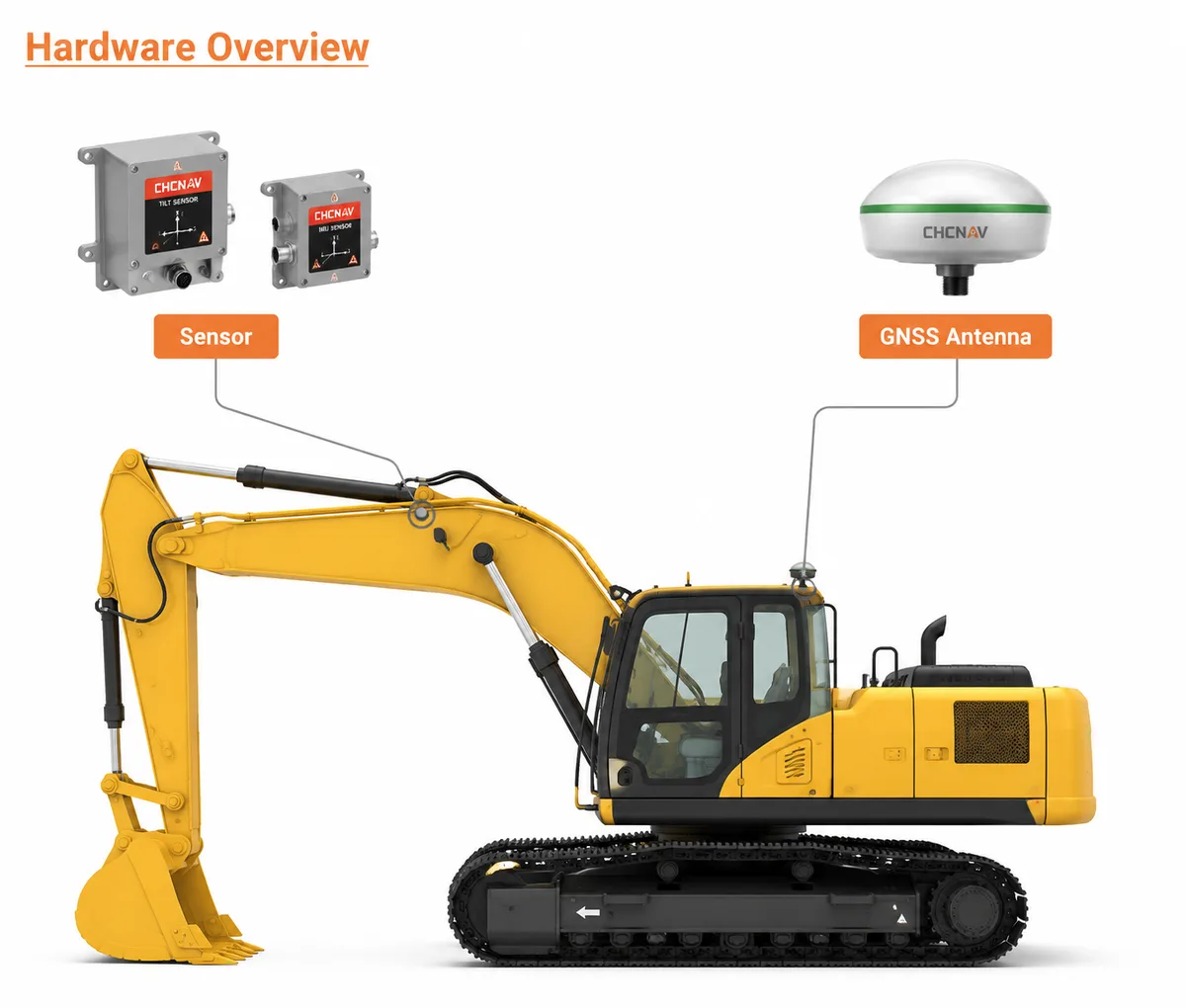
The hardware stack: GNSS antennas (one or two, the dual-antenna setup is the biggest single cost driver), receiver, IMU sensors on boom, arm, and bucket, in-cab display, mounting kit and cabling (or wireless kit).
The services: RTK correction subscription (annual), installation and calibration (usually a dealer service), and operator training (one to three days on site).
The single biggest variable is accuracy class. A system that holds ±2-3cm needs dual antennas, IMU sensors, and an RTK subscription. A system that only needs ±10cm can get away with a single antenna and no IMU. That gap is where most of the price difference comes from.
2026 Price Tiers: What Each Configuration Costs
| Configuration | Hardware | Install & Cal | Annual RTK | First-Year Total |
|---|---|---|---|---|
| 2D guidance (depth + slope, no GNSS) | $2,000-4,000 | $500-1,000 | $0 | $2,500-5,000 |
| Laser guidance (single plane) | $2,000-5,000 | $500-1,000 | $0 | $2,500-6,000 |
| Single-antenna GNSS (±10cm-class) | $6,000-10,000 | $800-1,500 | $0-800 | $6,800-12,300 |
| Dual-antenna GNSS + IMU (±3cm) | $12,000-20,000 | $1,500-3,000 | $800-1,500 | $14,300-24,500 |
Prices are typical 2026 market ranges for retrofit kits on a 20-30 ton excavator, before dealer discounts and regional variation.
What the Price Does Not Include
1. RTK correction subscription. Network RTK (NTRIP) runs $800 to $1,500 per year. A dedicated base station avoids the subscription but costs $3,000 to $6,000 upfront and needs setup and security on every site.
2. Setup time on each jobsite. A dual-antenna system with wireless installation takes 20 to 30 minutes to set up. Total station takes 30 to 60 minutes per setup. Laser needs re-leveling as work advances. At $85 per hour for machine and operator, setup time is a real line item.
3. Calibration drift. High-accuracy systems are sensitive to calibration drift. When an IMU sensor goes out of alignment, the machine stops until recalibration.
4. Operator training. Most operators reach 80% proficiency within 3 to 4 shifts, but the first shifts are slower than traditional digging. Budget the productivity dip.

ROI Payback Calculator (Worked Example)
| Input | Value | Monthly Impact |
|---|---|---|
| Hourly machine rate (excavator + fuel + operator) | $85 | – |
| Operating hours per month | 160 | – |
| Productivity gain from guidance (30%) | 48 hrs saved | +$4,080 |
| Grade checker eliminated | – | +$4,000 |
| Material savings (over-excavation reduced) | – | +$1,500 |
| Total monthly savings | System: $19,000 | $9,580 → payback ~2 months |
Formula: monthly savings = (hours saved × hourly rate) + (rework reduction × material cost) + (grade checker eliminated). Even at the conservative estimate (25% productivity, $3,000 checker, $1,000 material), the same system pays back in about 4 months.
KEY DATA POINT
A 2024 Construction Industry Institute study found machines running guidance 60%+ of operating hours were the only ones to pay back in under 12 months. Usage rate, not sticker price, decides payback.
NOT SUITABLE WHEN
One-off tiny digs, machines older than 15 years without hydraulic auxiliary ports, or sites where the design changes hourly without model updates. At those conditions the hardware cost outweighs the savings at every price tier.
Decision Engine: Should You Buy at This Price?
If your contract tolerance is ±3cm or tighter (structures, utilities, finished grade) → the dual-antenna GNSS + IMU system at $14,300-24,500 is not optional; no cheaper tier passes inspection.
If you run 160+ machine hours per month on precision work → the payback is 2 to 4 months, and the system should pay for itself this season.
If your work is ±10cm bulk earthworks and mass grading → a single-antenna GNSS system at $6,800-12,300 is the correct price point. The dual-antenna premium buys accuracy you will not use.
If you grade 1-2 days per month → the payback does not work at any price tier. Keep stakes and grade checkers.
If you rent machines or switch jobsites often → a wireless dual-antenna system that transfers between machines justifies the higher upfront price.
How to Compare Quotes Like a Buyer
- Ask for the first-year total, not the hardware price. Install, calibration, and RTK are part of the real cost.
- Confirm the configuration list. Dual antenna? IMU on all three linkages? Wireless installation? Cabled?
- Test the quoted accuracy. A system rated ±2-3cm in the lab can drift to ±5-6cm in the field. Ask for a calibration test section on your site.
- Check the RTK source. Network RTK needs cellular coverage. A dedicated base station costs more upfront but works where coverage is weak.
- Get the payback math in writing. Use the formula in this guide and ask the dealer to show their numbers.
Conclusion
The honest answer to “how much does excavator GPS guidance cost” is: $2,000 to $25,000, depending on the accuracy tier you actually need. The dual-antenna GNSS + IMU system that holds ±3cm costs $14,300 to $24,500 in the first year and pays back in 2 to 4 months on precision-heavy work. The single-antenna ±10cm-class system costs half and suits bulk earthworks.
Buy the tier that matches your contract tolerance, calculate payback with the formula in this guide, and get the first-year total in writing before you sign.
If You Only Remember One Thing
The first-year total for a dual-antenna GNSS + IMU system is $14,300-24,500, and it pays back in 2 to 4 months on machines running 160+ hours per month on precision work. Match the tier to your contract tolerance and calculate payback before buying.
Get a Custom Quote
Tell us your fleet size and the job types you run, and we will send pricing for the tier that fits your contract tolerances.
Frequently Asked Questions
References & External Resources
Industry research on machine control technology impact on earthwork productivity and payback
Manufacturer documentation on machine control technology
GNSS manufacturer perspective on system selection
Total station and machine control manufacturer product documentation
Practical contractor guide to machine control adoption
Operator training provider guide to guidance systems